

Across different cultures, people have always looked for ways to guess a baby’s sex before birth. Before ultrasounds and blood tests existed, families studied every tiny change in a pregnant woman’s body and tried to connect those changes to clues about the baby. One of the more unusual traditions is the belief that the hair at the back of a mother’s neck can serve as a form of gender prediction.
According to this belief, you lift the pregnant woman’s hair from the nape of her neck and look at the fine new hairs underneath. If these tiny hairs form a V shape, she is said to be having a boy. If they grow in a straight line across the lower hairline, the prediction points to a girl. This method is simple, fast and often used by older relatives who enjoy sharing folk knowledge passed down through generations.
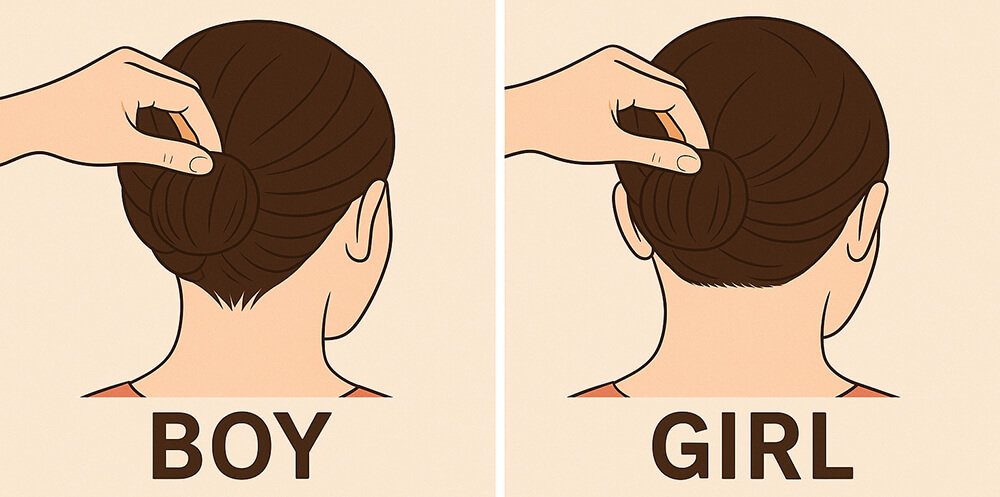
Where This Folk Belief Comes From
This particular prediction is not a Western old wives’ tale. It does not appear in European or American folklore. Instead, all the evidence points toward East Asian origins, especially within Chinese-speaking communities.
Chinese Yin-Yang Symbolism
In many traditional Chinese beliefs, boys were associated with yang, a form of rising, active energy. A sharper or rising pattern, such as a V, symbolised this upward force. Girls were associated with yin, a softer, calmer energy often represented through level, horizontal shapes. A straight hairline would therefore be interpreted as a girl.
This symbolic logic fits perfectly with the V shape = boy and straight line = girl interpretation, suggesting the belief emerged from yin-yang thinking rather than scientific observation.
Traditional Midwife Practices
Before modern healthcare, village midwives relied heavily on physical signs. They looked at belly shape, skin texture, hair growth, pulse quality, posture, and complexion. The nape of the neck was easy to examine, required no tools, and often changed during pregnancy. Over time, midwives linked visible patterns to the baby’s sex, feeding into the broader culture of gender prediction.
Back-Observation Traditions
In traditional Chinese medicine, examining the back of the body was believed to reveal hidden internal conditions. The lower back signified kidney strength, the spine was linked to qi flow, and even the hairline was considered meaningful. Observing the back of the neck would have felt natural in this diagnostic tradition.
Oral Tradition
Like many folk predictions, this method likely began as informal family knowledge, passed down verbally rather than documented. This explains why there is no single written origin point. Instead, it appears across rural Chinese communities, Taiwanese family customs, and Southeast Asian households with Chinese roots.
How Pregnancy Actually Affects Neck Hair
Genetic Hairline Patterns
A person’s natural hairline shape at the nape of the neck is largely determined by genetics. Some people naturally have a V shaped pattern. Others have rounded, uneven, or straight hairlines. Pregnancy does not change the structural hairline itself. It simply makes the fine hairs more noticeable.
Hormonal Influence
During pregnancy, hormones such as estrogen and progesterone change the hair growth cycle. These hormones may reduce shedding, keep more hairs in the growing phase, make fine hairs appear thicker, and increase overall visibility of baby hairs. This can give the illusion of new shapes forming, even when the underlying pattern has not changed.
Clothing and Friction
Collars, scarves, jackets, and long hair brushing the neck can also affect the tiny hairs at the nape. Since many pregnant women change their clothing for comfort, friction levels vary, creating slightly different growth or breakage patterns. This has nothing to do with the baby’s sex but can make hairlines look temporarily different.
Why the Belief Still Feels True
People Remember the Correct Predictions
If someone checks the neck hair and predicts a boy, and the baby turns out to be a boy, the story becomes memorable. Wrong predictions are usually forgotten. This creates the illusion that the method is more accurate than it actually is.
Pattern Recognition
When someone sees a clear V shape or a perfectly straight line, it is easy to attach meaning to it. Humans instinctively look for patterns, especially when the outcome is emotionally significant.
Cultural Warmth and Family Connection
Checking the nape of the neck often becomes a small ritual among mothers, grandmothers, and aunties. It gives families a way to bond, laugh, guess, and feel involved in the pregnancy. In that sense, the value of the tradition is emotional, not medical.
So Can Neck Hair Really Predict Gender?
Scientifically, no. The pattern of neck hair growth is shaped by genetics, normal hormonal changes, and simple environmental factors. It has no biological connection to the sex of the baby.
Culturally, however, the belief holds meaning. It is a small but memorable part of traditional gender prediction culture, especially in Chinese and Southeast Asian communities. It reminds us how people once interpreted the body, how they connected with pregnancy, and how family traditions were built through storytelling rather than technology.
Even if the prediction is unreliable, it carries history, warmth, and a sense of continuity. It shows the creative ways people tried to understand pregnancy long before modern tools existed.